
Who Reads Your Book Before It Ships?
On Monday, Nov. 9, Fortune reported that Spines raised $64 million to automate the work between a finished manuscript and a finished book. The company, based in New York and Israel, says it has published more than 8,000 authors and about 12,000 titles, using AI agents for editing, proofreading, formatting, cover design and distribution. Packages run from about $3,000 to $20,000.
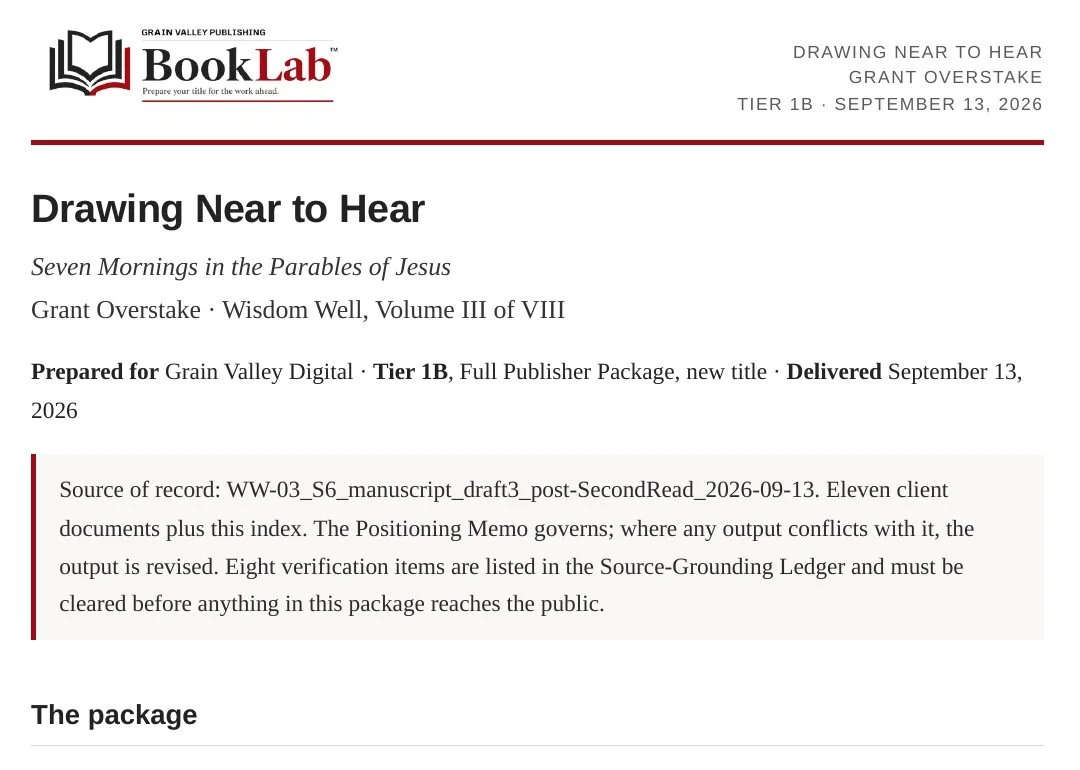
The first page of a BookLab package built for Grain Valley Publishing’s own title, Drawing Near to Hear. Source: Grain Valley Publishing.
Fortune calls Spines a hybrid publisher. The company describes its platform as an operating system for authors.
Spines makes its case on reading. CEO Yehuda Niv told Fortune that authors he has published in Israel kept raising the same complaint: “The cover designer didn’t have time to read my book.” He says Spines’ cover agent reads the manuscript first. Spines also says it publishes only books written entirely by humans, and Fortune reports that most of its roughly 350 employees work in customer success and support, helping authors with decisions software can’t make for them.
The question to ask any services partner
Who reads the manuscript, and at what stage? Ask a freelancer, an agency, a software platform or us. A good answer names the stage and the person who decides at it. A vague answer is worth a follow-up.
Where software helps and where a reader decides
Some steps suit software, such as file checks and formatting. Other steps depend on someone who has read the whole book: the edit and the brief a cover designer works from. For Catholic-market titles there is one more, the doctrinal review, which belongs to the publisher and its own reviewers.
How BookLab™ works
BookLab is the services arm of Grain Valley Publishing, and it works on other publishers’ titles. Grain Valley Publishing carried its own novels through editing, production and audio, written and edited by people, before AI tools came into the shop.
For each title, BookLab builds a package from the finished manuscript: Book DNA, the reference document every description is checked against, plus a positioning memo, copy, metadata and ideal-reader profiles. We use AI tools in that work. A person reads the book and decides what goes into every document, and each package carries a numbered ledger that traces every claim to its place in the book, so the publisher can check it.
A question for publishers
If you run a Catholic-market list, what does your services partner tell you about who reads your manuscripts? We would like to hear the answers. Write to us at grainvalleypress@gmail.com or use the form below.

You have a book that matters.
Maybe it is a backlist title that has been sitting quiet because the right rooms never heard about it in the right language. Maybe it is a new title that deserves stronger positioning than the launch copy captured. Maybe it is a title with real potential in Catholic institutional or secular markets that you have not had time to pursue.
You have done the work to get it this far. BookLab was built to take it the rest of the way.
What you get: a positioning statement, retail descriptions and metadata for your finished book, ready to use.
No obligation. You’ll hear back within forty-eight hours.
Let’s begin a conversation.
