
SecondRead™ Gives Editors a Second Pair of Eyes

On August 30, a magazine covering the international book trade argued that the best AI editing tools are not the ones that replace an editor. They are the ones an editor keeps on the desk. Michael Lemster, writing in Future Book Magazine, called “When AI Works Best as a Second Pair of Eyes.”
That is the job SecondRead™ has been doing out of Wichita since June.
What the article gets right
Machines are good at the work fatigue ruins. A repeated phrase. A place name spelled two ways. A character who ages two years inside one chapter of a 300-page manuscript.
Machines are poor at what comes next. Only a person decides whether an inconsistency is an error or an intention, whether a repetition is clumsy or chosen, whether a correction changes the meaning.
Lemster is blunt about the shortcut. Uploading a book and asking an AI to find its inconsistencies is not editorial method. Language models lose accuracy when the detail that matters sits in the middle of a long document, and the fixes for that problem do not carry from one editorial task to the next.
His order of operations is the part to keep. Use AI first for results a human can inspect: consistency checks, repetition reports, terminology enforcement. Keep it away from anything generative, above all where voice is the asset.
He ends this way: "The machine can scan the forest faster than any human. The commercial and editorial advantage will go to publishers that remember why they still need someone who knows which trees matter."
What happened at one ACP house this summer
In June I presented at the Association of Catholic Publishers annual meeting in Chicago. Rather than follow up with a brochure, I want to tell you what happened at one ACP house this summer. Greg Pierce at ACTA Publications sent me a manuscript and asked for a SecondRead.
Here is Greg's review:
"I sent Grant Overstake my final edited manuscript of a new novel by a first-time author for us, and asked for a SecondRead. What came back was a granular, page-cited report: where the manuscript contradicted itself, which claims held up against the public record, which ones needed a source or an author's note, and a plain summary of how much work stood between the book and where we wanted it. Nothing in the manuscript was changed.
"I forwarded the report to the author, who addressed almost every item himself without a call from me. What remained was the timeline question, and the report had mapped the problems clearly enough that we settled them in one conversation. For a small house with no fact-checking department, that is a valuable second set of eyes I could not have afforded any other way. It read, it reported, and it left the decisions to us. Saved me a ton of time, money, and potentially embarrassing mistakes."
— Gregory F. A. Pierce, President and Publisher, ACTA Publications.
What SecondRead is
That is what SecondRead is. Send us a Word or PDF, either is fine. Your file is converted to PDF on arrival, and I run that PDF through SecondRead AI, our proprietary manuscript-check system. Your original file goes back to you and is deleted from my system. Nobody here opens your Word document to work in it, because the work never happens in your file.
Every finding is reviewed by me before it reaches you. Nothing goes out based on machine confidence alone.
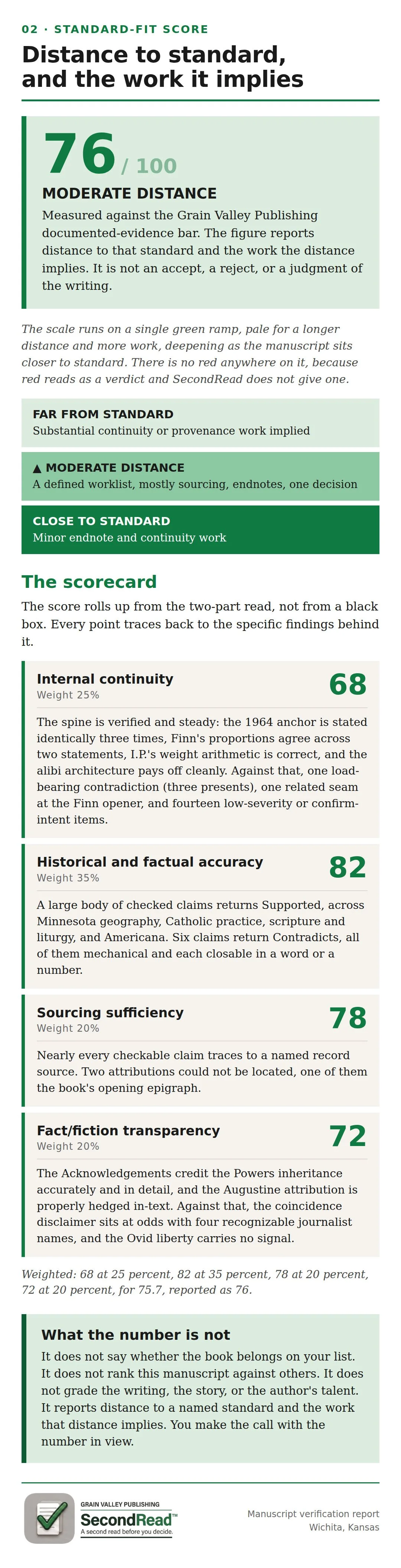
You will receive a two-part report: a continuity pass that flags every place the book disagrees with itself (page-cited), and an accuracy pass that sorts every claim against the record and names the source. It closes with a worklist and a score indicating how far the manuscript is from your house's standard.
The findings come back in a fixed vocabulary. Continuity items are rated Low for a cosmetic fix, Craft note for an opportunity rather than an error, and Confirm intent for something that looks deliberate and needs the author's word. Claims carry a verdict: Supported, Supported (tradition), Contradicts, From [source], or Liberty. Departures from the record are named as the author's choices, not corrected, so they can be owned in an author's note instead of caught by a reviewer.
Two limits, stated up front
No read catches everything, and I do not claim this one does. And it never touches the manuscript. It reads, it reports, and the author and editor decide.
How to start
Go to the SecondRead page and click Send Your Manuscript. It opens a message to me with the intake fields already filled in: title, word count, and the house or imprint it is aimed at. Attach a Word or PDF, either is fine. You will have a confirmed price and delivery date within two business days, and nothing is due until you say go. Members of the Association of Catholic Publishers and the Kansas Authors Club have a reduced rate through October 31, listed on that page.
At the Kansas Authors Club convention, October 2 to 4

The 2026 Kansas Writing Convention runs October 2 through 4 at Rock Springs Ranch near Junction City, on the theme "Writing Our History and Creating Our Future: Building Community Right," with historian Ken Spurgeon giving the keynote. Registration closes September 15.
Everything above is written for houses. This part is for writers working on their own.
Bring or send a PDF of the first fifteen pages of a manuscript you believe is finished and you get a short SecondRead back at no charge. Pages 1 through 15 only, reported only from that sample, and nothing in your manuscript is changed. The first dozen writers get notes inside a week. After that, closer to two.
FirstFifteen is free through October 31. Go to the SecondRead page and click Send Your Manuscript, then mark FirstFifteen yes and Kansas Authors Club yes. Or find me at Rock Springs Ranch, October 2 through 4, and hand me the pages.
Lemster is right that the advantage goes to the people who know which trees matter. That has always been the editor. The question worth asking is what you hand them before they walk into the forest.