
Most Coming-of-Age Novels Have the Same Engine (First Person Narrative)
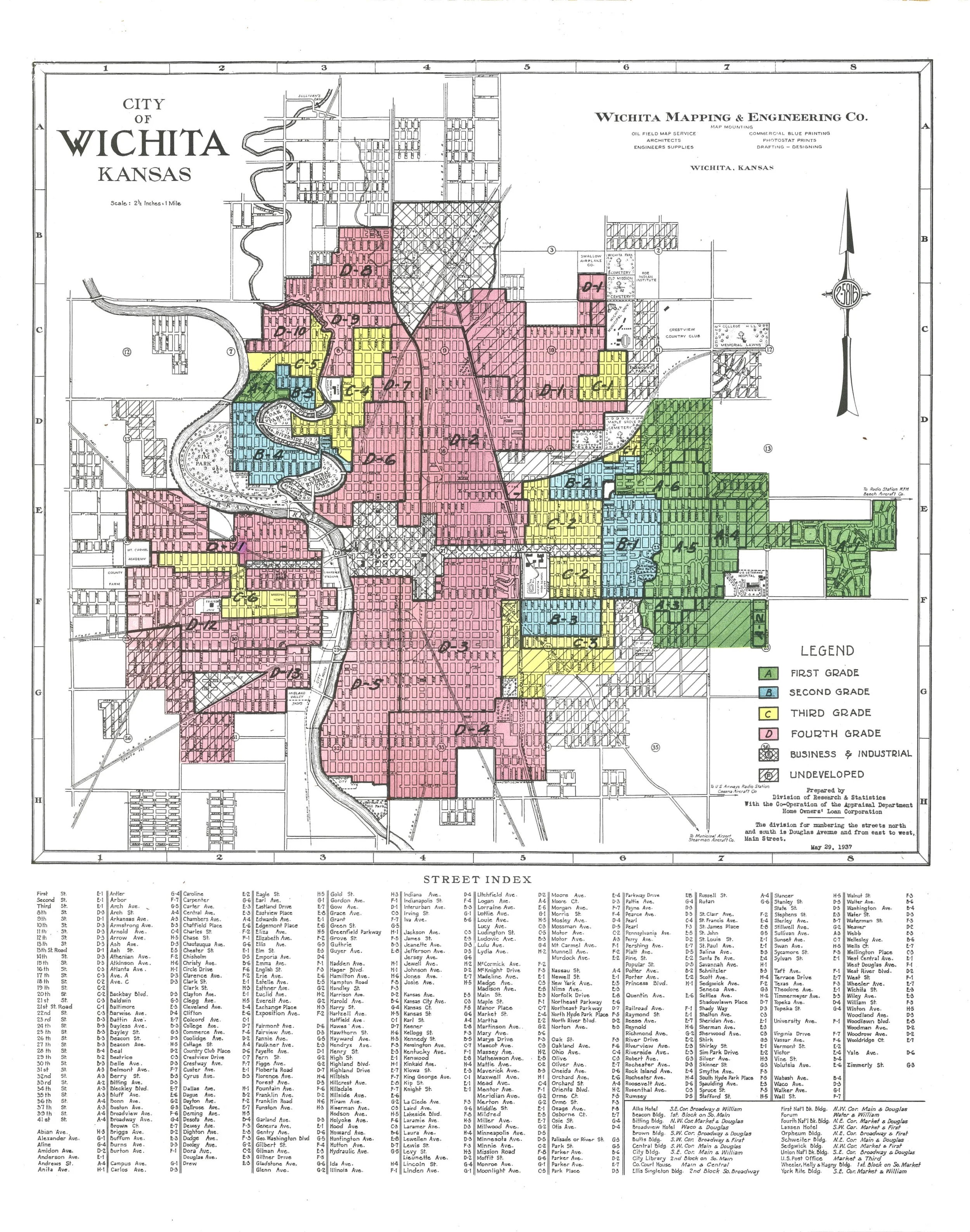
Home Owners’ Loan Corporation appraisers graded every residential block in Wichita on this map, dated May 29, 1937. Areas shaded red were rated fourth grade, the lowest of the four ratings lenders used. Source: Mapping Inequality, University of Richmond, from City Survey Files, National Archives.
Collider published a ranked list on Aug. 10 of the ten best coming-of-age books ever written. "To Kill a Mockingbird" took the top spot. "IT" was second, "The Outsiders" third, "The Catcher in the Rye" fourth.
Look at that top four again. Three of them are already on English department reading lists, and they got there because teachers put them there. The coming-of-age canon is one of the few canons built largely by classroom demand rather than by critics.
So it is worth asking what those books have in common, because the answer is more specific than "growing up," and it explains why the genre is so hard to replace once you have found a title that works.
The engine is a narrating voice
Three of Collider's top four are told in first person by the young person living through it. Scout tells you about Maycomb. Ponyboy tells you about the Curtis brothers. Holden tells you about everything, at length, whether you asked or not. "Jane Eyre" and "The Body" make it five of the ten.
First person is not a stylistic preference in this genre. It is the equipment. The whole event happens on the inside. A third-person narrator can report that a boy changed his mind. Only the boy can let you hear him doing it, and let you hear him get it wrong first.
That is also why the genre produces the most argumentative narrators in fiction. A kid whose account of the world is coming apart starts talking back to it. Holden built a career on it. He contradicts, he objects, he calls things phony, and the reader spends three hundred pages inside a running argument between a boy and adults he cannot argue with out loud.
Students recognize that voice immediately. It is the closest thing literature has to the inside of their own heads.
What TJ Crowley sounds like
"The Real Education of TJ Crowley: Coming of Age on the Redline" opens in July 1968. Wichita is under curfew. TJ is 13, a seventh-grader, keeping watch at the picture window while his mother drinks in the kitchen. She threatens to wash his mouth out with soap.
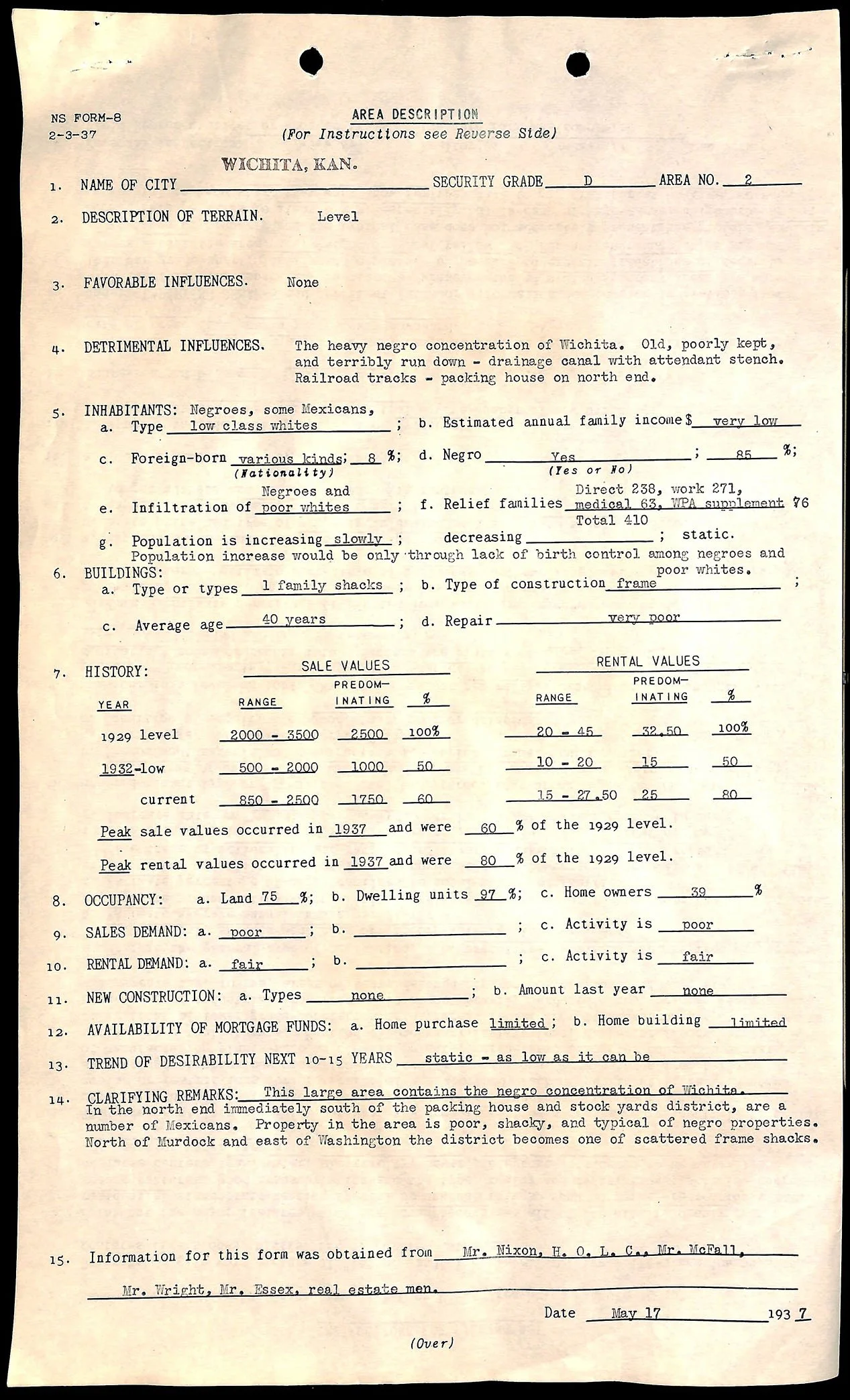
Federal appraisers completed a description form for each graded area of Wichita in 1937. Under “favorable influences,” the form for Area D2 reads “None.” Source: Mapping Inequality, University of Richmond, from City Survey Files, National Archives.
He does not say anything back. He thinks it: No, she won't. She can't, because I'm thirteen now. Besides, she's drunk again.
That is the book in four lines. A boy who argues with his mother in his own head, argues with a classmate out loud, argues with his own bad shot-put throw, and eventually has to argue with what he has been raised to believe. He is combative before he is thoughtful, and the order matters. A boy who was already gentle would have nothing to come of age out of.
The part that is different, and the part teachers ask about first
Every book on Collider's list is one you read silently. TJ Crowley exists twice.
It won the 2025 Audie Award for Best Young Adult Audiobook as a full-cast production with fifteen actors, and the complete performance script is published as a book. AudioFile Magazine gave the production an Earphones Award and called the narrators of this fraught coming-of-age story excellent.
Normally a script strips out interiority. Dialogue only, no inner voice, which is the wrong shape for this genre. This one keeps both. TJ's first-person narration is printed as prose, running between the character cues, with the other fifteen voices coming in around it. A scene on the page reads like this: TJ tells you what he sees and what he is not saying, then his mother speaks, then the man at the door speaks, then TJ tells you what he made of it.
Read it and you are in his head. Play the audio at the same time and the room fills in around you. His mother is in the kitchen. The sirens are outside. The news is on.
In a classroom, audio teaches tone, dialect, and pacing from evidence students can hear and keeps struggling readers moving with the group. Students can follow the printed text while the cast performs. The text supports close reading; the audio adds what silent reading misses.
The premise, and what it asks of a reader
Wichita in 1968 was a redlined city. The line ran through TJ's neighborhood, and it was drawn by policy.
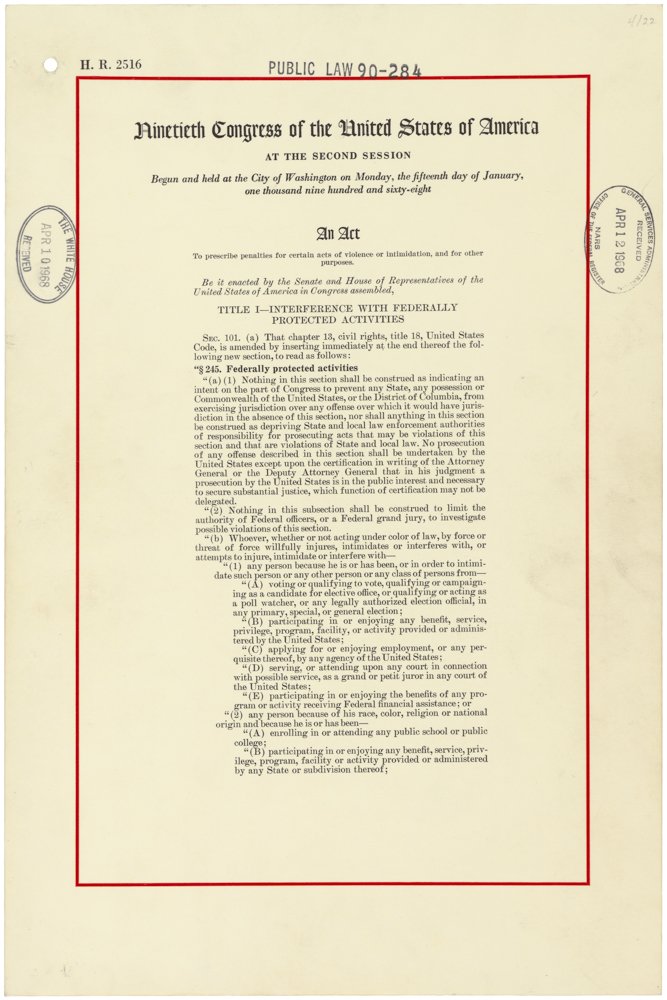
President Lyndon Johnson signed Public Law 90-284 on April 11, 1968, three months before the July in which the novel opens. Its Title VIII is the federal fair housing law. In the novel, when the Washingtons move in, TJ's mother slams the door. Source: National Archives and Records Administration.
When Dr. Robert Washington, a Black physician, comes to the door to introduce his family as the new neighbors, TJ's mother, Kate, calls him a slur and slams it. Her boyfriend, Raymond Hatcher, is a Klansman. TJ has been raised inside that and knows the rules of his block. Then he is ordered to help build a fence.
What follows is not a boy watching prejudice happen to other people. It is a boy finding it in his own mouth. He is taught by people who are not trying to teach him: a gas station attendant who sees more than he says, a doctor who plays old recordings of spirituals in his garage and coaches a kid through a shot-put ring, a woman at a table stacked with envelopes who explains that white dentists in Wichita would schedule Black patients only on Thursday afternoons, and that a group of women is putting a stop to it.
The Washingtons are fictional. Their model was not. The scriptbook credits Dr. Val Brown Sr., one of Wichita's first Black physicians to gain hospital privileges, and his wife, Josephine Brown, a music educator, founder of the ARISE Ensemble, and the first Black woman elected to the local school board. In the audio production their daughter, Sheila Brown Kinnard, performs the role modeled on her own mother.
The book is frank. It carries a content advisory for violence and historical racist language, and it recommends grades nine through twelve, for mature teen and adult readers. A companion guide exists for teachers who want help running the conversation. If you are looking for a book that softens 1968, this is not it. If you have been looking for one that does not, that is the whole reason it was written this way.
Where the Mockingbird comparison stops
Readers reach for "To Kill a Mockingbird" with this book, and on setting and subject the reach is fair. The difference is worth naming, because it is the design.
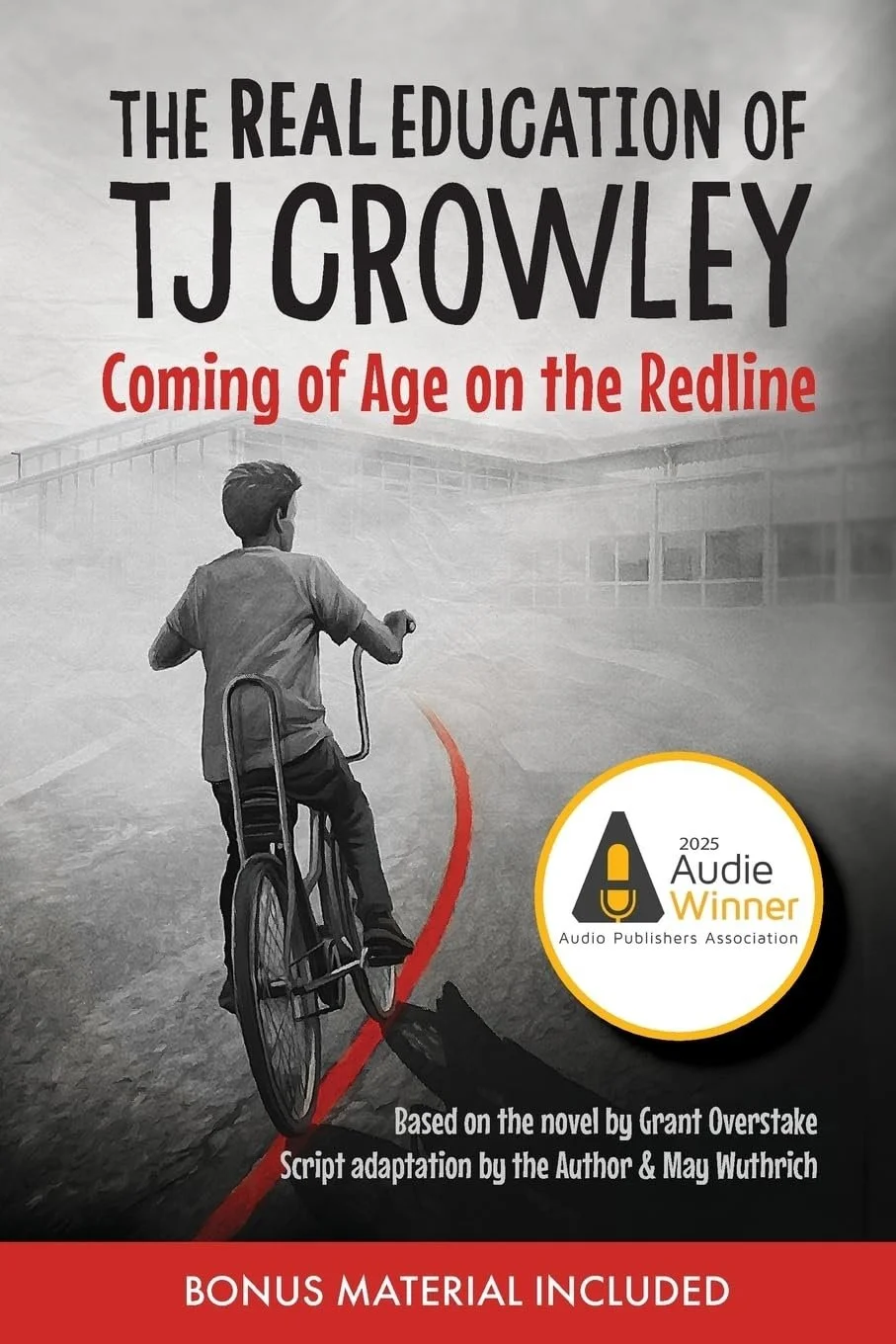
TJ's first-person narration is printed as prose between the character cues. Read his thoughts on the page while fifteen actors perform the scene around him.
Scout has Atticus. There is a moral center already installed in her house, and her growth is largely the growth of her vision. She learns to see what her father already sees.
TJ has Kate and Uncle Ray. The moral authority in this story lives next door, behind the fence he was told to build, in a family his mother insulted on their first day in the neighborhood. TJ does not grow by learning to see what his parents see. He grows by breaking with them.
That is a harder shape for a classroom and a more useful one, because it does not let a student stand next to the good adult and feel safe.
The short version
A coming-of-age story asks what a young person does with what they were handed. It asks in first person, because the change happens where only the narrator can see it. Collider's list is a good place to start if you want the canon.
If you want one where the handed-down thing is racism, the setting is an American city with a real red line drawn through it, and students can read the boy's thoughts while hearing his neighborhood, that is this one.
TJ Crowley and his family are invented. Wichita's redlining, its curfews in the summer of 1968, and the aftermath of Dr. King's killing are not.
The scriptbook and the audio drama are at grainvalleypublishing.com/scriptbook-edition. Grades nine through twelve, with a content advisory.